How I build
What you’re hiring is judgment — how someone decides what to build, what to leave out, and what still holds up two years later.
A logo wall doesn’t show you that. It shows you who paid. So here’s the work itself: a client platform taken from vision to production, and one of my own builds opened up end to end. Twenty years of the rest sits under NDA or behind a login, and I’ll walk you through whatever’s relevant on a call.
A membership platform, vision to production
Client engagement — details anonymized. I’ll walk you through it on a call.
The brief
A non-technical founder with a clear vision for a professional community platform, and no way to build it. The job wasn’t just writing code — it was turning what they pictured into decisions about what the platform actually needed to do, then building and shipping it.
What I built
- A multi-step member application and approval workflow
- A custom admin dashboard for reviewing and managing applicants
- Role-based automated email sequences — welcome, decision, follow-up
- Full email-delivery infrastructure: authentication, DNS, deliverability
- Payment-ready architecture and a content-management layer
Next.js, Postgres, integrated email and CRM automation, cloud hosting — the same boring-on-purpose stack I’d bring to yours.
The part most developers skip
I didn’t build it and hand over a repo. I shipped it live, supported it in production, and fixed real issues under pressure — coordinating the whole way with a founder who doesn’t speak software.
Taking a vision from someone who can’t spec it themselves, and delivering the thing they actually meant — that’s the hardest part of this work, and the most valuable.
Result. A live, working platform — idea to production, built and supported by the same person who scoped it.
Salon Ops AI
Why it exists
I’m opening a children’s hair salon franchise. Before signing a lease and a personal guaranty, I wanted to know what the business actually did under different assumptions — staffing levels, rent, the ramp to break-even, what happens if revenue comes in twenty percent light.
What I had was what most owners have: spreadsheets, guesswork, and a franchisor’s proforma that stops where the real questions start.
So I built the tool I needed.
What it does
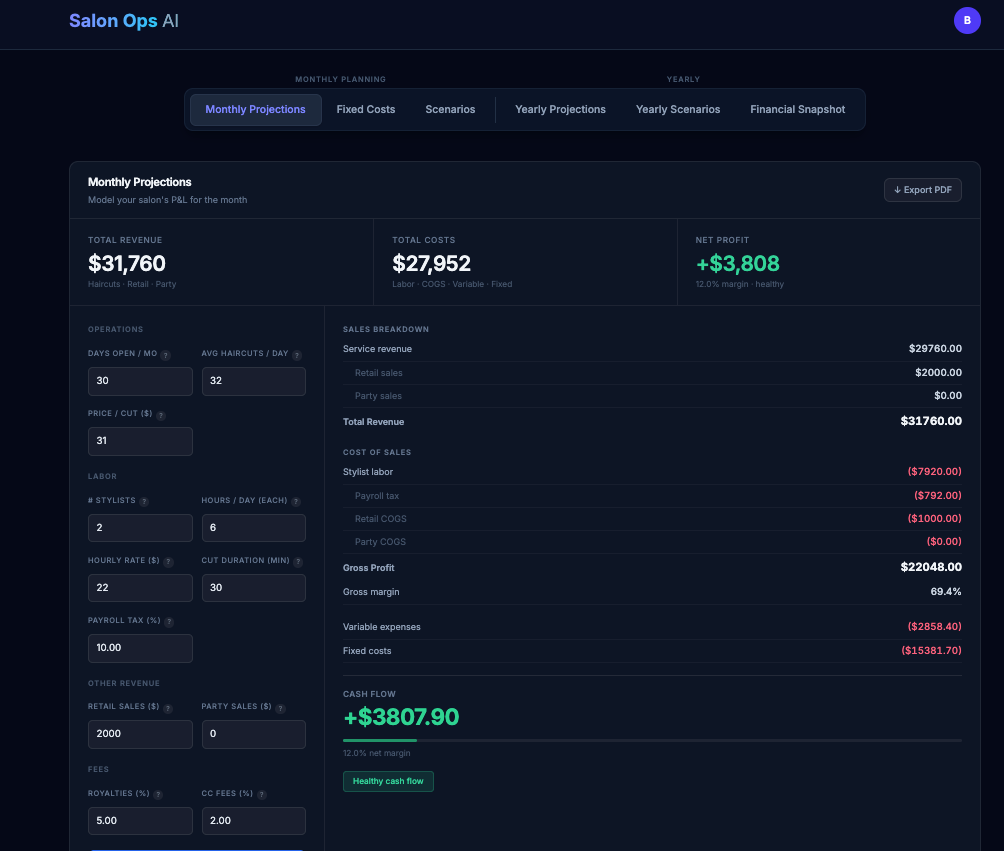
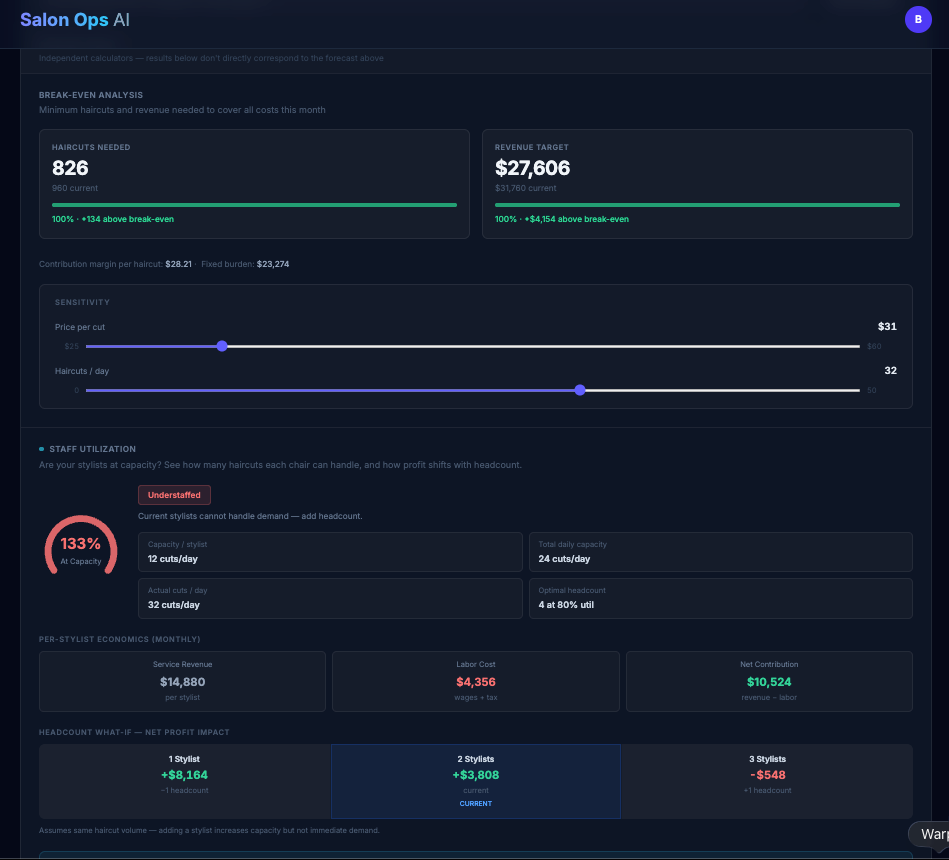
A financial forecasting application for salon operations. You put in the levers an owner actually controls — price per cut, haircuts a day, stylists and their hours, retail, rent, royalties, card fees — and it runs the month: revenue, cost of sales, gross margin, and what’s left as cash. Then it answers the questions that come next: how many haircuts it takes to cover everything, what one dollar on the price does, and whether the chairs can physically handle the demand the forecast assumes.
Right now it tells me the month clears $3,808, that I’m understaffed, and that hiring another stylist would erase the profit. All three are true at once. Holding them together is the reason I wanted software instead of a spreadsheet.
Status. I built it for my own franchise and use it to run the numbers — working software doing a real job, not a demo.
The decisions behind it
Model the business, not the spreadsheet.
The easy version is a calculator with fields. The useful version understands how the pieces relate — staffing drives capacity, capacity drives revenue, revenue changes what staffing you can afford. Getting that model right is the whole job.
Boring infrastructure on purpose.
Postgres and managed hosting. Nothing clever. Clever infrastructure is a bill that arrives eighteen months later.
Why this matters for your project
Your platform isn’t a salon forecaster. But the work is the same shape: logic that lives in your head and a spreadsheet needs to become software that holds up when the business changes.
That translation is the actual craft. The forms and the buttons are the easy part.